
Cloud cost allocation is one of the most frustrating FinOps capabilities. You know you are overspending on shared services, but you can’t prove it. Your dashboards are noisy. And when it’s time to explain costs to product or business teams? Out comes the spreadsheet. That is not sustainable.
At Ternary, we think cost attribution should be automatic, flexible and business aware—not a quarterly nightmare. And with our new unified cost allocation and billing rules engine, that is exactly what you will get.
Why does cost allocation matter?
Cost allocation isn’t just a finance exercise but the foundation of a transparent, accountable, and efficient cloud operation. Until now, many teams were constrained by rigid cost reallocation tools that did not reflect the realities of modern cloud spending, like shared services, cross-functional teams, usage-based chargebacks, and evolving cost models.
The problem: Cost data that doesn’t tell the full story
Cloud billing data wasn’t built for how modern teams work.
- Shared services like support, platform engineering, or compliance don’t show up in team budgets
- Preview SKUs or internal-only charges skew actual cost views
- Business units can’t get meaningful showback or chargeback
- And the fixes? Usually a mess of manual spreadsheets that are outdated before completion
With Ternary, you can finally model real-world business logic natively in a purpose-built FinOps platform, without offline spreadsheets or manual adjustments.
The Ternary way: A unified billing engine that makes your data work for you
We have merged Ternary Cost Allocation with our MSP Billing Rules Engine, creating a single, powerful engine for all customers.
With this enhancement, direct customers now have access to advanced billing actions like rerating, backing out line items and adjusting to list, which were previously exclusive to managed service providers (MSPs).
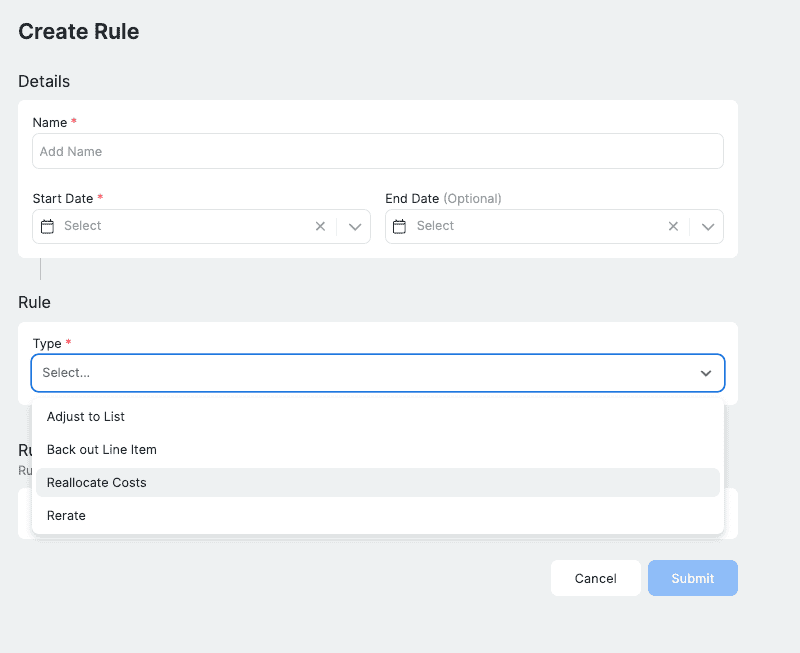
The unified Ternary Billing Rules Engine also introduces granular control over rule creation and prioritization. You can now build complex rules with ease and adjust their execution order using the intuitive drag and drop functionality. This enhancement streamlines rule management and empowers both direct customers and partners to manage cloud costs with greater precision.
Here are the available rule types for direct customers:
- Reallocate Costs. Split shared charges fairly by a fixed percentage or based on usage
- Rerate. Apply markups or discounts to reflect your true transfer pricing
- Back Out Line Items. Exclude irrelevant charges from your dashboards and reports
- Adjust to List. Normalize pricing to list rates for transparency
Before vs. after: How Ternary changes the game
Here is what happens when you replace spreadsheets with Ternary’s billing rules:
| Without Ternary | With Ternary |
|---|---|
| Cloud bills don’t reflect reality—shared services live in a separate bucket | Shared services are automatically reallocated to teams based on consumption |
| Finance and engineering spend hours reconciling numbers | Automated daily updates keep allocation current and auditable |
| Discounts, credits and adjustments are tracked manually in spreadsheets | Built-in rerating applies discounts, markups or list adjustments seamlessly |
| Inaccurate or irrelevant SKUs skew reporting | Backing out the line items removes noises from dashboards and KPIs |
| No clear, defensible showback or chargeback | Transparent cost attribution every stakeholder can trust |
Real-world use cases
Here is how FinOps teams are already using these extended cloud cost allocation rules:
- Shared services attribution
- Problem: Central platform or support teams are not reflected in individual team costs.
- Solution: Use the Reallocate Costs rule type to split shared support charged across all consuming projects based on usage.
- Static example: Split equally across (example – 5 teams).
- Dynamic example: Weighted by each team’s cost share.
- Internal transfer pricing
- Problem: Your FinOps team needs to model internal rates different from actual billed rates.
- Solution: Use the Rerate rule type to apply a 15% uplift on all compute resources for internal cost tracking.
- Remove inapplicable charges
- Problem: Some line items (like R&D preview SKUs or manual refunds) should not impact dashboards or KPIs.
- Solution: Use the Back Out Line Item rule type to suppress line items with sku_name = preview_service_x.
- Normalize to list prices for transparency
- Problem: You want teams to see what their costs would be at list rates to encourage usage efficiency.
- Solution: Apply the Adjust to List rule type with a 0% offset or +10% to show potential growth impact.
- Prioritized logic with rule execution order
Combine rules and set execution priority to control sequencing.
- Rerate to transfer pricing
- Reallocate to teams
- Back out irrelevant line items
Ternary executes them in order to maintain clean, predictable outputs.
The impact: Cleaner data, smarter decisions
With Ternary you can:
- Layer rules in a sequence that matches your business needs—no more one-size-fits-all allocation
- Show teams their true costs including shared services and overhead
- Create accurate, defensible reports for finance, leadership, and product owners
- Drive better unit economics by connecting costs to consumption
- Eliminate spreadsheet reconciliation and manual workarounds
Ready for smarter cloud cost attribution?
Your cloud costs should tell the story of your business—and now they can.
If you have been living in spreadsheets or struggling to explain where your cloud spend really goes, it’s time to see what Ternary can do.
Smarter cost attribution starts now.
See how Ternary turns complex cloud bills into actionable business insights.