
When it comes to Oracle Cloud cost management, the built-in native tools are free and provide a solid starting point. They offer basic visibility and budgeting features that help organizations take the first steps in tracking spend. But native features aren’t enough for most enterprises. You’ll eventually have to resort to third-party Oracle cloud cost management tools for more advanced capabilities.
In this blog, we’ll look at the top cost management tools available today and explore their key capabilities for Oracle Cloud Infrastructure (OCI).
But first, let’s dive into the limitations of native Oracle tools.
Limitations of native Oracle cost management tools
Oracle’s native tools such as the FinOps Hub, Cost Analysis, Cloud Advisor, Cost Estimator, and Budgets help teams get started with cloud cost management, but they fall short of delivering full FinOps capabilities.
The OCI FinOps Hub provides visibility into costs by region, compartment, and product, and it supports budget creation and basic forecasting. Cloud Advisor adds simple optimization recommendations.
However, these tools stop at surface-level insights. They lack critical FinOps functions like anomaly detection, granular cost allocation, unit economics, and governance workflows. As a result, teams that rely only on OCI’s native console struggle to move beyond basic tracking and into proactive, data-driven cost management.
Key benefits of third-party Oracle Cloud cost management tools
Before introducing you to the top Oracle Cloud cost management tools, let’s discuss why you even need them.
Broadly speaking, these tools give you a clear picture of what’s happening, who’s spending what, and where you can stop the financial bleeding.
Here’s where these tools extend Oracle’s native offerings:
- Multi-cloud visibility. From our experience, most organizations use Oracle as a second, third, or fourth cloud, mixed in with others. It’s rarely their primary cloud. So, a third-party cloud cost management tool becomes necessary to gain visibility into all your cloud spending along with OCI.
- Cost allocation. One of the biggest headaches in the cloud is figuring out which department racked up which bill. To address this issue, FinOps tools provide tagging and labeling mechanisms to charge expenses back to the right teams to encourage them to use cloud cautiously.
- Anomaly detection. Third-party tools help you detect cloud cost anomalies and uncover root causes quickly. This helps you take a more proactive approach to cost control and prevent budget overruns.
- Unit economics. Cloud bills are massive, complex, and often disconnected from business value. A FinOps platform takes raw usage data and ties it directly to business drivers (e.g., per user, per transaction, per API call).
Top tools for Oracle Cloud
Before diving in, it’s important to note that no third-party platforms currently provide automated cost optimization recommendations for Oracle Cloud Infrastructure (OCI). Instead, these tools focus on delivering clear visibility into your OCI spending. With that in mind, let’s explore some of the leading Oracle Cloud cost management tools available today.
1. Ternary

Ternary is a multi-cloud FinOps platform that supports Oracle Cloud Infrastructure along with AWS, Azure, Google Cloud, and Alibaba Cloud. It leverages the FinOps Open Cost and Usage Specification (FOCUSTM) schema to deliver normalized cost data and consistent reporting across providers.
This unified visibility benefits both finance and engineering teams. Finance leaders can easily track consumption trends, forecast budgets, and understand the financial impact of cloud usage. Engineering teams gain the ability to pinpoint inefficiencies and identify exactly where waste is occurring.
Additionally, managed service providers (MSPs) benefit from Ternary’s multi-tenant design and robust customer management capabilities, enabling them to deliver differentiated FinOps services to customers worldwide.
Key features:
- Flexible and agentless deployment. Ternary’s agentless architecture and the ability to deploy as a SaaS or Self-Hosted solution give customers the flexibility of choice.
- Self-service customization. Teams define their own cost labels and can build multi-cloud reports and dashboards easily.
- Anomaly detection. Ternary provides real-time Oracle Cloud anomaly detection with configurable alerts and thresholds.
2. CloudHealth
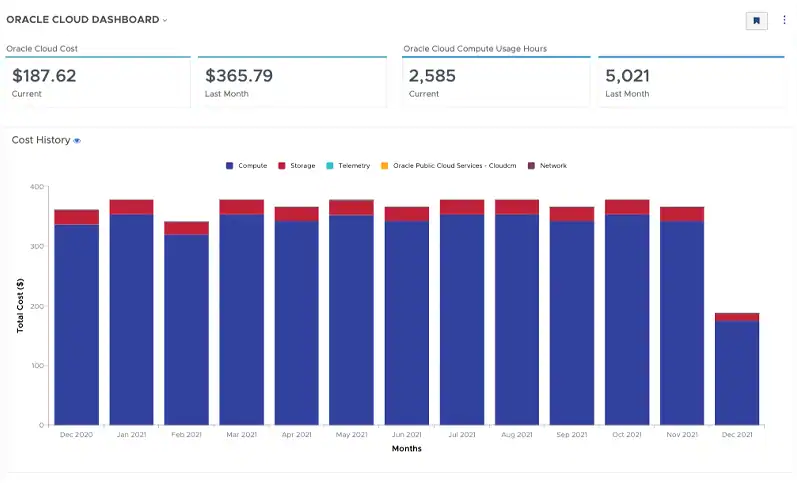
CloudHealth, formerly known as VMware Tanzu CloudHealth by Broadcom, is a powerful multi-cloud cost management platform designed for enterprises that need to control cloud spending while maintaining compliance at scale. In 2020, CloudHealth became the first cost management solution to support Oracle Cloud Infrastructure, extending its visibility across the four major cloud providers.
Key features:
- FlexOrgs and Perspectives for advanced role-based access control and customized business groupings.
- Asset inventory for detailing all services and billing data supported for Oracle.
- Governance policy engine to enforce budget, optimization, and security rules etc. MSPs also benefit from its ability to maintain strict policy enforcement across diverse client infrastructures.
3. IBM Cloudability
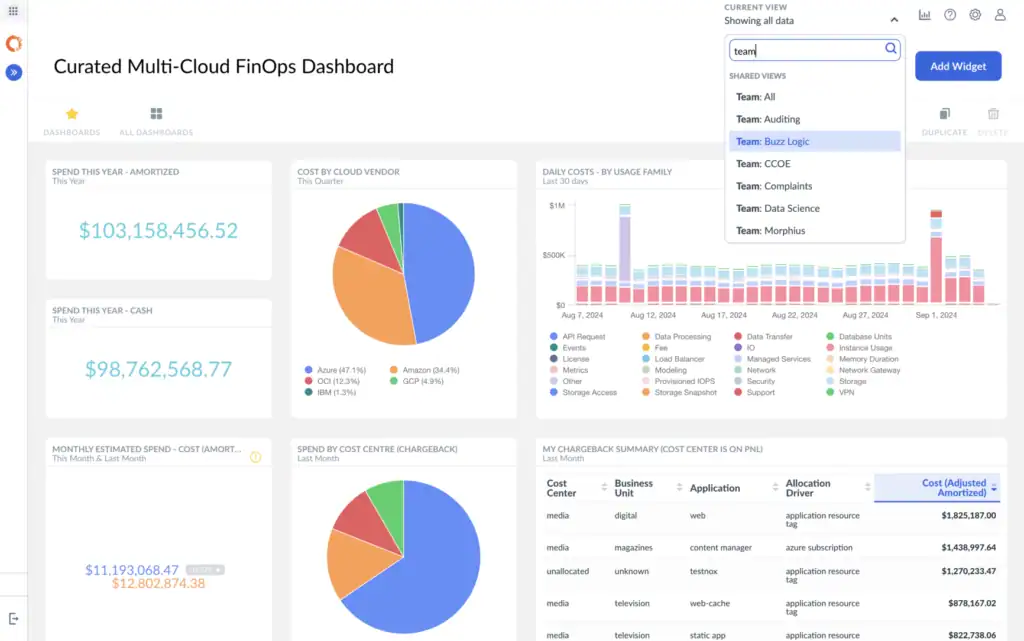
IBM Cloudability, formerly Apptio Cloudability, is one of the earliest cloud cost management solutions and has long catered to finance-driven FinOps teams. Its OCI integration is a more recent addition. In June 2023, Cloudability introduced OCI support, enabling multi-cloud customers to track and analyze Oracle Cloud costs alongside AWS, Azure, and Google Cloud within a unified dashboard.
Key features:
- Cloudability supports custom dashboards and reports for Oracle Cloud that align with formats you already use for other cloud platforms.
- Business mapping to group costs by business units, projects, or functions.
- KPI scorecards for gamification and driving efficiency across teams.
4. Vantage

Vantage is a cloud cost observability platform known for its quick setup and intuitive interface, making it easy for teams to gain visibility into their cloud spend. Its OCI integration connects through a read-only IAM user and API key linked to your OCI Cost and Usage Reports bucket. Once connected, Vantage refreshes cost data on a daily basis.
Key features:
- You can link multiple Oracle Cloud tenancies from a single integrations page, and Vantage will automatically ingest and visualize the data.
- Lets teams slice and dice costs across dimensions (tags, business units, accounts) with hierarchical reporting, virtual tagging, and unit-cost metrics
- Vantage notifies you of budget alerts for Oracle in real time, helping you address issues quickly.
5. Kion
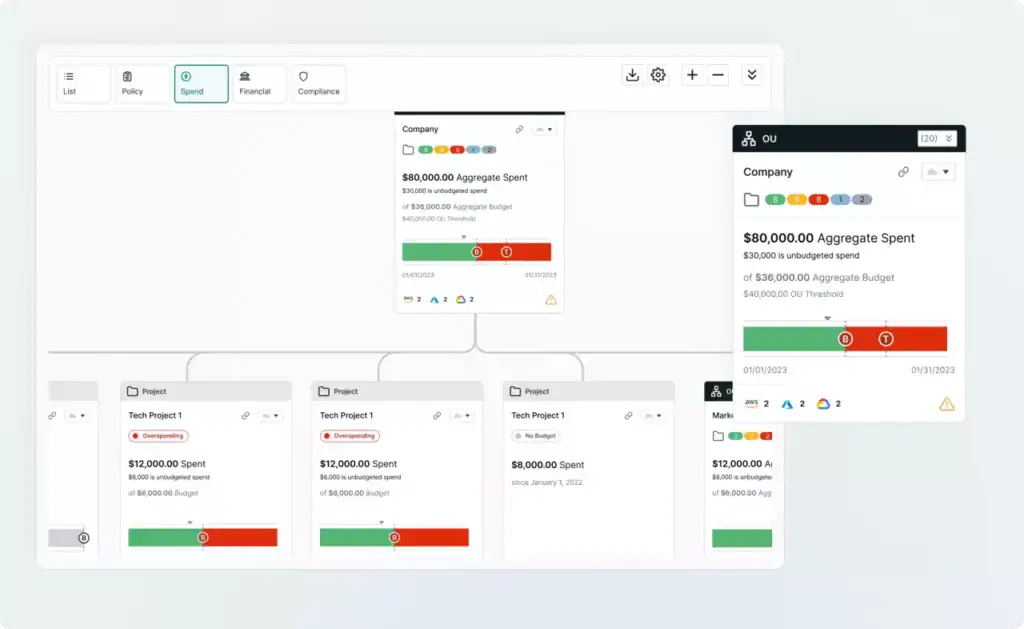
Kion is a cloud operations platform that combines cost visibility with access control and compliance. Worth noting, Kion is only available as a self-hosted solution.
- Centralized spend tracking across AWS, Azure, GCP, and OCI.
- Budget guardrails with real-time alerts and policy enforcement
- Its governance-first approach ensures that all new cloud projects automatically inherit policies, permissions, and rules.
6. Flexera
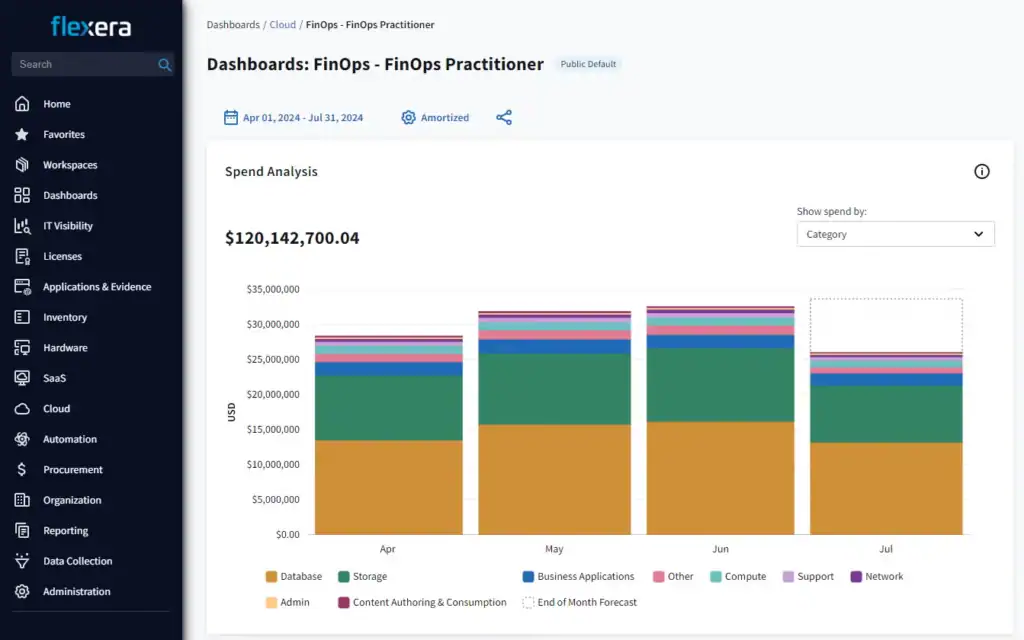
Flexera One is another third-party solution with Oracle support. It provides you a single framework for reporting, chargebacks, and scenario modeling, even if your infrastructure spans multiple environments. That said, it’s worth noting that FinOps support for Oracle is still evolving.
Key features:
- Enterprise-level cost visibility spans cloud, on-premises infrastructure, and SaaS licensing.
- Flexera integrates with OCI using FOCUSTM billing data and can automatically pull in cost reports on a schedule.
- Verified Oracle Software Asset Management (SAM) tools to help ensure the accuracy of your licensing data and stay protected from software audits.
Key considerations before choosing a tool
Choosing the right Oracle Cloud cost management tool comes down to your organization’s size, scale, and how you actually operate.
If you have a smaller or a highly centralized setup, a spreadsheet with careful manual tagging might be enough. But once you’ve got multiple teams spinning up instances and governance can’t reliably enforce tagging rules, it’s usually time to move beyond manual tracking and adopt a dedicated solution.
The following considerations can help you pick the right tool:
- Determine how cloud purchasing is handled. If operational teams buy cloud instances directly without centralized oversight, you’ll need stricter controls and alerts to prevent cloud overspending. But, if IT has tight control, a lighter governance layer may be enough for you. So make sure the third-party Oracle tool supports these.
- Check support for advanced budgeting and forecasting. See if cost management tools let you set thresholds and get alerts when spending nears those limits. Third-party tools should also expand on this with forecasting models and more granular budget targets.
- Evaluate whether third-party tools fill critical gaps. Identify which FinOps capabilities are most important to your organization, and assess tools based on the depth and breadth of their feature set. Pay special attention to capabilities such as anomaly detection, unit economics, and governance workflows.
Final thoughts
Third-party cost management solutions help FinOps, engineering, and finance teams manage costs effectively.
Among the options we explored, Ternary stands out as the strongest choice for Oracle Cloud cost management.
With transparent pricing, multi-cloud support, and a design philosophy rooted in solving real-world cost challenges, it’s one of the few platforms that feels built for both finance and engineering teams.
Get started with Oracle Cloud cost control.
FAQ
What is cost management vs. cost optimization for Oracle Cloud?
Oracle cost management tracks, analyzes, and reports on cloud infrastructure costs. Cloud cost optimization, on the other hand, is the process of actively reducing cloud expenses while maintaining performance.
How does OCI billing work and how do I estimate my costs?
Oracle Cloud pricing comes in two different billing models.
- With Universal Credits (Annual Flex), you prepay for a set amount of cloud services over a certain period (1 year, let’s say). Universal Credits work like a project budget, which means that you need to monitor spending closely to avoid unused credits.
- With Pay-As-You-Go, you only pay for what you use, but at higher rates, which makes efficiency critical.
To estimate costs, Oracle provides the OCI Cost Estimator.
How can I actually reduce my Oracle Cloud (OCI) bill?
You can reduce or save on your Oracle Cloud bill by applying a mix of native features and best practices. The most effective steps include:
- Using consistent resource tagging and metadata to track costs.
- Setting budgets and forecasts to monitor spending.
- Enabling anomaly detection and alerts for unusual charges.
- Rightsizing resources to match actual demand.
- Implementing chargeback or showback reporting for accountability.